
"You Just Fired a Thousand Workers — Where Are You Going Next?"
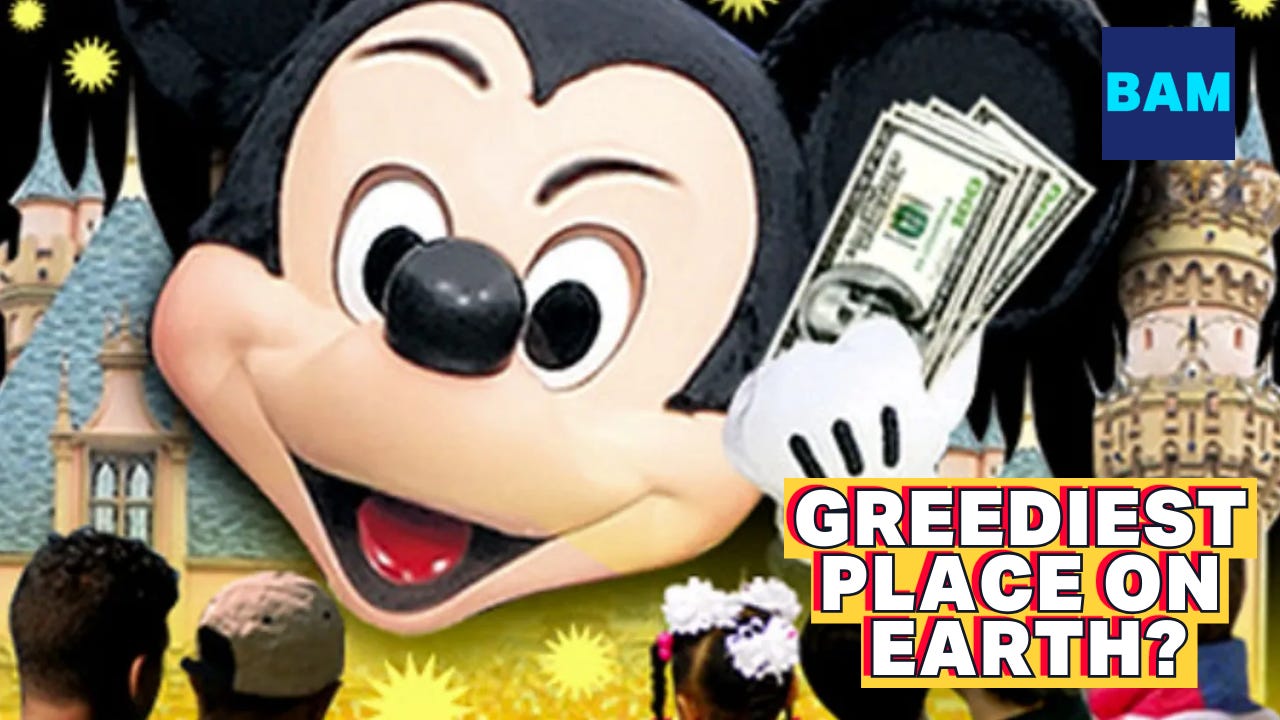
$45M for Disney's CEO. Zero dollars in federal taxes. $4.7 billion in government rebates. A $7 billion stock buyback. The Magic Kingdom has stopped pretending.
Cliff’s Note: The only thing standing between working Americans and the full, unapologetic extraction machine David Shuster describes below is independent media willing to name names and show receipts. That work—David’s reporting, the livestreams, the accountability, the stuff corporate outlets won’t touch—is paid for by our Community Members.
If you want Blue Amp to keep publishing pieces like this one, please become a paid subscriber today. 🙏 👊
By David Shuster
American capitalism has long been exceptionally greedy. Rapaciousness, after all, is as old as commerce itself. But in the United States under Trump, even the faintest pretense of embarrassment has been obliterated. What was once done with a wink is now performed with a trumpet.
Consider the latest performance at the Magic Kingdom. The newly anointed chief executive officer of the Walt Disney company, Josh D’Amaro, has been awarded a compensation package worth $45 million a year.
At the same time, D’Amaro just signed off on the firing of 1,000 company employees, as if they were defective bolts rattling loose on Space Mountain.
Disney leadership is speaking solemnly about “efficiencies,” the most elastic of modern corporate euphemisms.
But let’s not stop there. Disney has contrived, by perfectly legal means, to pay an effective federal income tax rate of zero. Zero! It is a figure that would have astonished even the most creative accountants of the Gilded Age. Meanwhile, Disney last year accepted 4.7 billion dollars in U.S. government rebates—public money, extracted from the very citizenry now asked to applaud the firings and layoffs.
And now, to reassure analysts and investors on Wall Street that Disney’s relatively anemic stock performance is getting a boost, Disney is planning to spend $7 billion buying back its own stock. The chief virtue of this maneuver will be to inflate Disney stock prices, further lifting the fortunes of Disney stockholders and executives.
If this is not greed, then the word has lost all meaning.
Conservative corporate apologists, of course, are already clearing their throats. They insist, with the enthusiasm of Maurice from Beauty and the Beast instructing his daughter Belle, that each of these acts is defensible in isolation.
The pay is “performance based.” The layoffs are “strategic.” The taxes are “optimized.” The buybacks are “value-enhancing.” Thus Disney, like other modern corporations, gets to disassemble its conduct into a series of bloodless abstractions, each scrubbed clean of consequence.
But many Americans, despite our nation’s embrace of obscene individual and corporate greed, still have the vulgar habit of considering the whole of our society. And we can see that at Disney and countless other corporate icons, the game has been rigged. The winnings flow upwards, the losses downward, and the Disney financiers and speculators congratulate themselves on their skills and dexterity.
Ironically, there was once was a time in America, improbable as it now sounds, when captains of industry exhibited some restraint. Take Mitt Romney’s father George Romney, who ran American Motors in an era when the word “millionaire” still retained a whiff of astonishment.
Romney voluntarily declined $268,000 in pay over five years—roughly a fifth of what he might have taken—and in 1960 refused a $100,000 bonus on the grounds that it would push him above a self-imposed ceiling of $225,000. He had previously informed his board, in a fit of what today would be diagnosed as moral derangement, that no executive needed to earn more than that.
George Romney was no monk. He lived well, ate well, and doubtless slept soundly. But he labored under the conviction that there existed some relationship—however tenuous—between what corporate leaders took for themselves and the general health of the society around them.
Such thinking has since been annihilated.
At the Magic Kingdom, and throughout American capitalism, we have erected and embraced a system in which excess is not just tolerated but celebrated, in which the ability to extract the maximum possible sum is regarded as a mark of genius, and in which any appeal to proportion or fairness is dismissed as the whining of the liberal left.
And it’s not just about CEO pay, worker layoffs, and obscene corporate tax rates. Most Americans who have visited Disney World in recent years will tell you that the park has become exceptionally expensive. A Mickey’s Chocolate Covered Ice Cream Bar now costs $6.50 each. That’s more than twice the price from 15 years ago and far exceeds the rate of inflation.
A Mickey pretzel has gone up by 118% and now costs $8.25. And never mind giving your kid a soft pretzel or ice cream treat, a basic “Mickey Ears hat” has also soared well beyond inflation. 15 years ago, it was $11.95. Now, the mouse hat will set you back $20 plus taxes.
Just getting into the theme park has also outpaced inflation. Over the past ten years, the price of admission has doubled.
The price gouging and corporate profit taking at Disney is obscene. And this similar corporate strategy across America has a long term cost on our basic humanity. The U.S. labor force is perpetually on edge. The U.S. treasury keeps being treated as a trough for the billionaire class. And the gulf is getting wider between those who make governmental and business decisions and those who endure them.
Trust, that fragile and necessary lubricant of any functioning society, is evaporating. Cynicism is rushing in to take its place.
And still the show goes on, brighter than ever, the music louder, the costumes more extravagant. One is reminded of that famous Disney commercial with the music of “When you wish upon a star,” in which a grinning victorious NFL star is asked, “You’ve just won the Super Bowl—where are you going next?” The answer, delivered with rehearsed jubilation, is always the same: “I’m going to Disney World.”
Today, in this era of unabashed greed, the question and answer should be altered. “Corporate CEO, you’ve just shed a thousand workers, paid no taxes, and secured yourself a king’s ransom—where are you going next?” The answer, stripped of its confetti, would be just as predictable: “straight to the bank, by way of Disney World.”


The greed is appalling…
This is some very sad and frightening stuff. Of course, Disney holds a special place in most hearts. Whether it's a favorite movie, beloved character or dear memory, Disney has touched most of us. That is why the points you make pack such an impact. You've used Disney as the representative "big business" that's essentially screwing us so it hits home.
Just how much money does anyone really need? These numbers are obscene. No one earns or deserves these insane amounts of money - no one. Especially with so much need in the world. And these people will never have enough. They will always lust for more, and do whatever immoral deeds are necessary to acquire it. Makes me wonder if they even think about the fact that in doing so, they have sold their souls.