



Cliff’s Note:
I have been doing this for a long time, and I have never once written the words “a Democrat leads in Kansas” about a Senate race. Until this week.
Below is the whole map as I see it forty-three days out: the states Republicans assumed they could ignore, the ones where the numbers have stopped being funny, and my honest call on how this ends.
Kansas is free. The rest is for members. Five bucks a month, and nobody upstairs telling me to soften the call.
—Cliff
by Cliff Schecter
I know what you’re thinking: Donald Trump couldn’t possibly screw up everything could he? Iran, food-price inflation, Epstein Files, farm bankruptcies, diesel and gas through the roof, angry relatives of deportees, cattle ranchers crashing, massive personal corruption? I’m kidding, it’s Donald Trump—who we kidding here—the guy still hasn’t screwed up as many presidencies as he has marriages and businesses. In political parlance, we would say he “still has room to grow.”

And that’s where we start looking at the Senate playing field, rubbing our eyes in disbelief, and look again to see the numbers haven’t changed. They are not, in fact, a mirage to be adjusted downward later like every Trump jobs report. This is real. And Trump, to use a technical term, is f*ked.
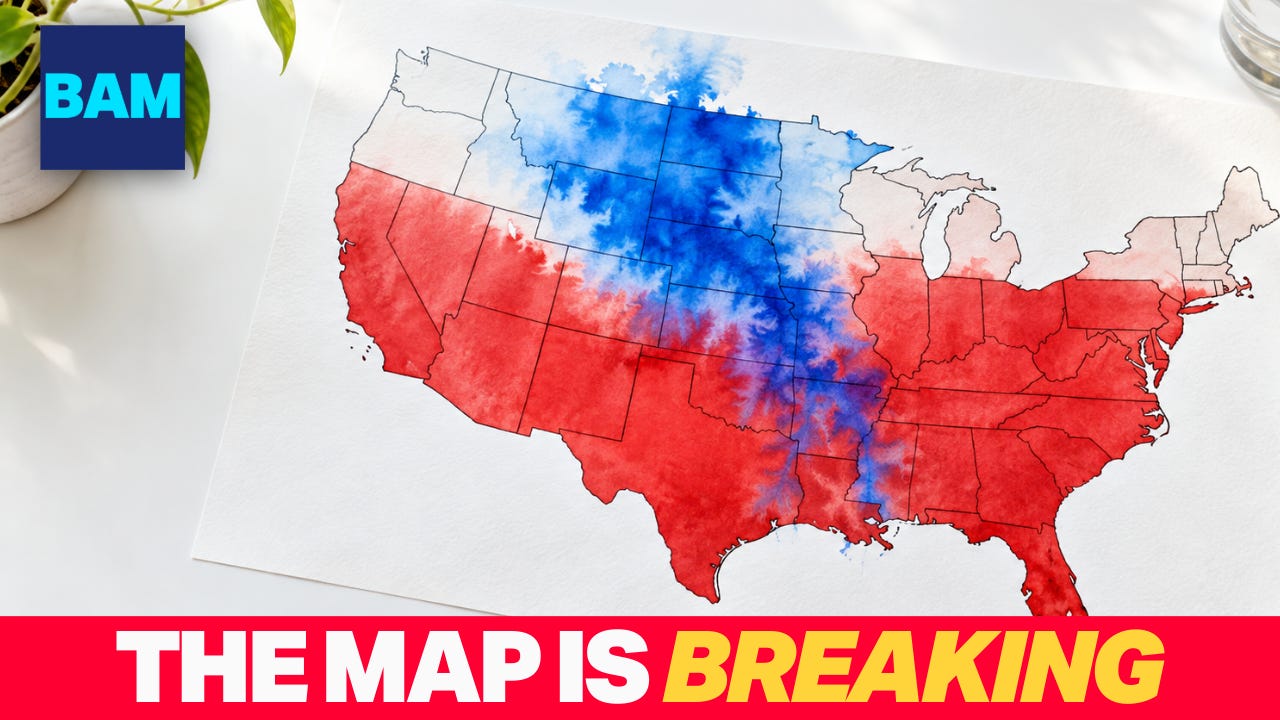
Yes, the 2026 Senate playing field has expanded far beyond the handful of states in which Democrats were originally expected to pose a challenge. North Carolina, Maine, Michigan and even Ohio—with the talented former Senator Sherrod Brown making a comeback—remain central. But Alaska, Iowa, Texas, South Dakota, Montana, Idaho(!), Kansas, Nebraska, Florida, Arkansas, and South Carolina are now receiving serious attention.
That does not mean Democrats will win all—or even most—of them. It means a combination of the Iran war, historically high diesel and gasoline prices, continuing controversy over the Epstein files, ethics concerns surrounding Donald Trump Don-Corleone-level corruption (and Fredo-Corleone-level IQ) and stronger-than-expected Democratic recruitment has altered the political environment so profoundly this could be a 50-year storm. Trump and congressional Republicans entered this election believing many of these states were safely beyond Democrats’ reach. Instead, an administration confronting emerging economic pitchforks and cratering public approval has helped place an extraordinary number of Senate races on the national radar.

Kansas has to be the clearest illustration. Democrats have not won a Senate election in the state since 1932. Yet Republican Roger Marshall is facing Adam Hamilton, a prominent Methodist megachurch pastor (the largest Methodist church in the state, and country) running on affordability, cooperation, and political decency. Former Republican governor Bill Graves has crossed party lines to endorse Hamilton, while notably cautious election analysts have moved the race away from the safest GOP category. Kansas voters are experiencing the effects of soaring fuel prices, tariffs, and the Trump’s idiotic Iran War—issues that resonate particularly strong in an agricultural state.

Per the Kansas City Star:
In the new poll, 44.8% of respondents on Sept. 15-16 said they would likely vote for Hamilton compared to 43.3% for Marshall and 3.7% for Libertarian nominee David C. Graham. Undecided voters accounted for 8.2% of the sample.
‘This poll finds Democrats with their best chance to win their first Senate seat in Kansas since 1932, in part driven by Democrat Hamilton’s appeal to independent voters, leading by 15 points, 42% to 27%,’ said Spencer Kimball, executive director of Emerson College Polling, in the new report.
Yes, Democrats currently hold the governor’s office in Kansas, and elected another Democratic governor not too long ago. But this still doesn’t change the fact that Kansas hasn’t sent a Democrat to the Senate in 94 years—which is somehow a year before Chuck Grassley was born, which I thought might’ve been somewhere close to the dawn of time.
And you ain’t seen nothin’ yet. There’s this other state, ya see, called Nebraska.
